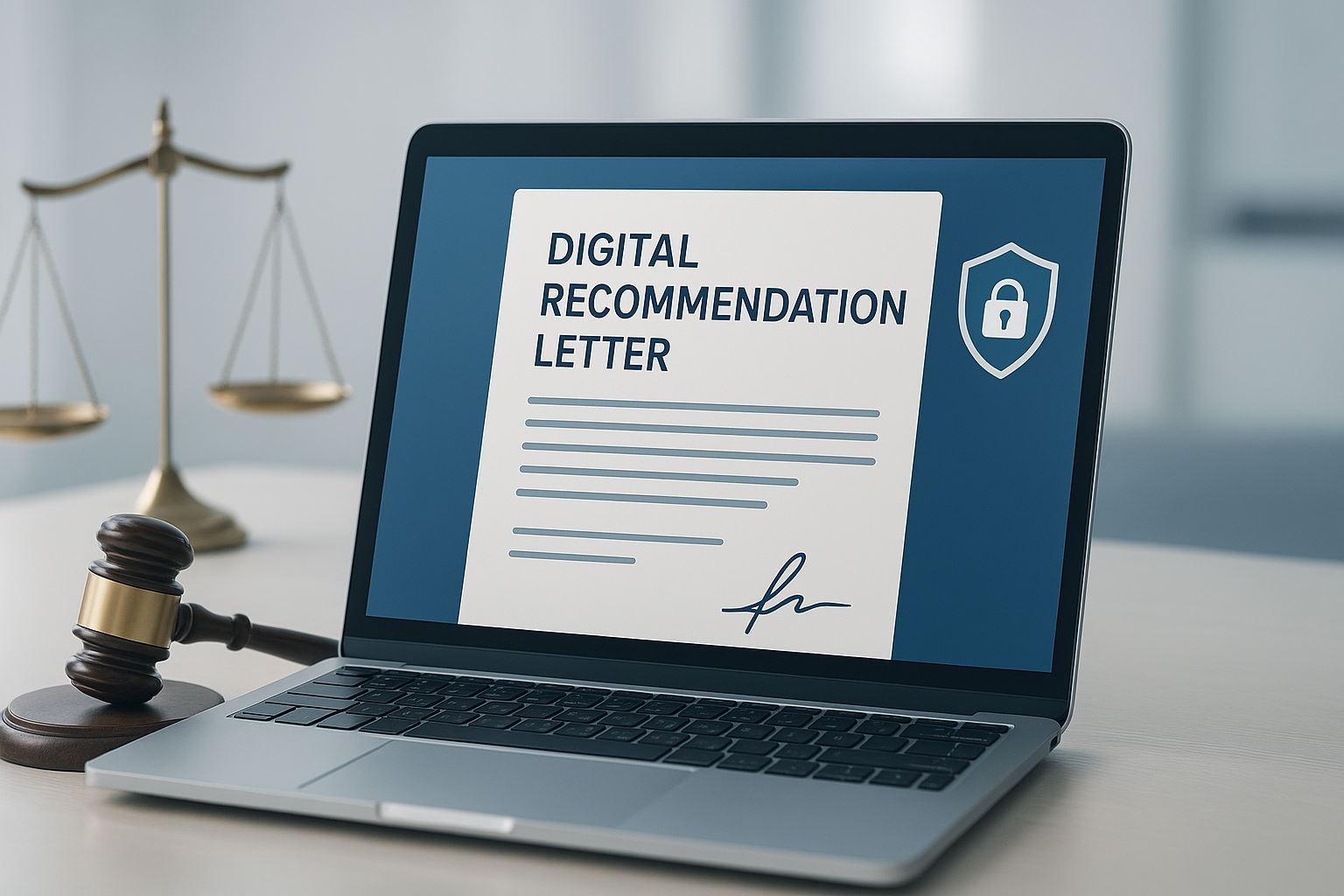
In today’s digital-first world, recommendation letters have surpassed paper-based formats and made their way into email inboxes, LinkedIn profiles, and specialized platforms like Recommendas. For both professionals and companies, digital recommendation letters offer unmatched convenience, authenticity, and portability. However, as with all digital assets that carry personal data, reputational impact, and legal implications, there are critical legal factors to consider.
In this blog, we’ll explore the legal considerations of using digital recommendation letters, especially when using platforms like Recommendas, a new but promising platform that’s reshaping how individuals and businesses collect, manage, and share endorsements.
Digital recommendation letters are:
Yet with these advantages come serious legal responsibilities, specifically around privacy, consent, intellectual property, data retention, and authenticity.
When a person writes a digital recommendation letter, it often contains personal information such as names, job titles, contact details, and sometimes sensitive personal anecdotes. Since these letters are digital, they are stored and transmitted electronically, making them vulnerable to unauthorized access or misuse.
Data privacy laws, such as the GDPR (General Data Protection Regulation) in Europe and the CCPA (California Consumer Privacy Act) in the United States, have established stringent rules for handling personal data. Failure to comply with these regulations can result in severe penalties for both businesses and platforms containing such data.
Digital signatures are an important part of digital recommendation letters. They provide authenticity and legal validity, confirming that the recommender has agreed to the contents of the letter and is giving permission to share it.
In the United States, the ESIGN Act, and in the European Union, eIDAS (Electronic Identification and Trust Services), establish the legality of electronic signatures, making them equivalent to handwritten ones in most cases.
A digital recommendation letter is a work of authorship, raising questions about ownership. Typically, the recommender retains copyright over the letter, while the recipient has permission to use it for specific purposes such as applications or admissions.
Under laws like GDPR, explicit consent is mandatory before collecting or processing personal data from both recommenders and recipients.
A recommendation letter’s value lies in its authenticity. Since these letters influence hiring and admissions, they must be verifiable, tamper-proof, and traceable.
Recommendas allows users to showcase their letters publicly, a great visibility tool for job seekers, but one that requires privacy awareness. Letters often contain sensitive data, so exposure must be managed carefully.
Transparency is the foundation of every credible digital system, especially one built around personal endorsements. When users upload or request recommendation letters, they’re trusting the platform with their professional reputation. That’s why clarity in how data is handled, accessed, and stored is non-negotiable.
Recommendas sets itself apart by offering clear visibility into every step of the process, from consent and storage to visibility and deletion. Users are informed, not just involved. This type of transparency builds digital confidence and creates a traceable trail that supports compliance with global privacy laws like GDPR and CCPA.
Ultimately, transparency doesn’t just satisfy regulations, it inspires confidence. It transforms digital recommendation letters from static documents into living, trustworthy credentials that carry weight across applications, admissions, and professional networks.
Consent management ensures that users’ rights are respected during data collection and processing. For digital recommendation letters, this applies to both the writer and recipient.
Recommendas ensures that every legal angle is covered through robust compliance practices:
As technology advances, so do regulatory expectations. The next generation of digital recommendation system will need to conform not just with data protection laws, but also with AI ethics, cross-border data handling, and evolving digital identity frameworks.
Recommendas is already taking steps toward this future. With scalable encryption, blockchain-readiness, and adaptive compliance layers, it’s engineered for a world where verified digital credentials are standard. This forward-thinking approach means users don’t just comply with the law today, they stay compliant tomorrow.
For educational institutions, recruiters, and individuals alike, this creates peace of mind and a long-term foundation of trust. Recommendas isn’t just keeping up with legal evolution; it’s driving it, redefining what compliance means in a world where credibility and technology intersect.
With the rise of AI tools like ChatGPT integrated into platforms like Recommendas, questions of authorship, data use, and bias are emerging. To maintain fairness and transparency, it ensures full disclosure when AI tools assist in editing and provides opt-out options for users.
As AI in digital recommendation continues shaping how letters are written and reviewed, Recommendas’ approach, rooted in ethics and transparency, will remain the benchmark for legally and morally responsible innovation.
As more professionals turn to digital platforms to collect, manage, and showcase their recommendation letters, the legal landscape around digital documentation will continue to evolve. From data privacy and e-signatures to intellectual property and consent management, it’s crucial to ensure that all aspects of the digital recommendation process are legally sound.
Recommendas leads the way by prioritizing:
By addressing these critical areas, it empowers both recommenders and recipients to exchange professional endorsements confidently, securely, and in full compliance with global legal standards.
In a world where trust and technology intersect, Recommendas ensures your digital recommendation letters are not only credible, but legally sound.