In today’s fast-paced digital work environment, hiring is no longer about simply filling a position; it’s about finding people who fit right, perform, and grow with the organization. Employers have powerful tools at their disposal, screening systems, background checks, and AI-driven resume filters, still even with all these innovations, something essential often gets lost in the process: the human story.
That’s where the debate of screening vs recommendation begins.
Screening gives you data.
Recommendation gives you depth.
One evaluates candidates based on qualifications; the other reveals the person behind the profile. When combined reflectively, they create a powerful hiring strategy built on both evidence and empathy.
Let’s dive into how these two approaches differ, why recommendation letters still matter in an age of automation, and how platforms like Recommendas are redefining how organizations balance efficiency with authenticity in modern hiring.
Screening is the foundation of most recruitment processes. It’s systematic, fast, and designed to reduce the number of applicants to a manageable shortlist.
In short, screening is the “sorting phase.” It identifies who appears qualified, but not necessarily who truly fits for the role.
Screening methods serve an important purpose:
For example, a data analyst role might require specific technical certifications or proven experience with software tools. Automated screening ensures that only those meeting these criteria move forward.
However, screening alone misses what can’t be measured on paper.
A resume can’t tell you:
Automated systems also introduce bias of their own. Candidates who lack the right keywords or unconventional career paths often get filtered out, even if they could excel.
That’s where recommendation letters bring value back into the equation, offering insight no algorithm can replicate.
A recommendation letter is not a checklist; it’s a narrative. It’s a personal account from someone who has worked with, led, or mentored the candidate, someone who can speak to both skill and character.
When comparing screening vs recommendation, recommendation letters bring a depth of understanding that data cannot match. They humanize the process.
Example:
“During our busiest quarter, Jane led her team through a high-stakes project with empathy and precision, earning client praise and setting a new internal benchmark.”
That single statement reveals more about leadership and reliability than a bullet point on a resume ever could.
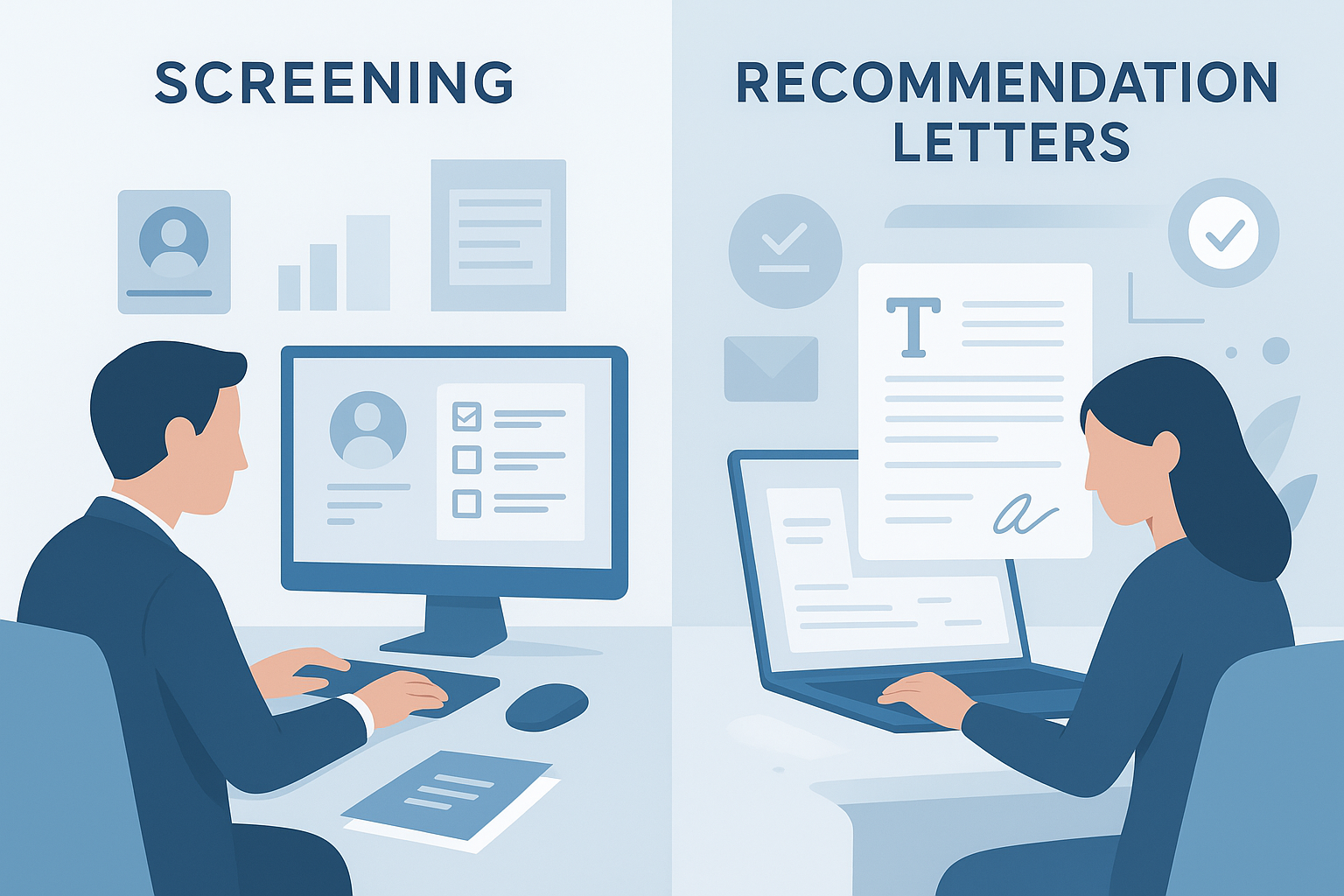
The difference between screening vs recommendation becomes clear when you look at how each approach contributes to the hiring process. Both play essential roles; one ensures efficiency, the other builds trust, but their focus, tone, and impact differ greatly.
When combined, screening vs recommendation becomes less of a debate and more of a partnership.
Screening identifies potential. Recommendation confirms promise.
Together, they create a hiring process that values both competence and character.
Automation has its appeal. AI screening tools can process thousands of resumes in seconds, but speed can sacrifice substance.
The screening vs recommendation balance tips in favor of recommendation when emotional intelligence, leadership, or teamwork are key success factors.
Recommendation letters add a vital human lens to hiring decisions. They tell stories about how people think, act, and grow.
A good recommendation letter doesn’t just repeat the resume; it reframes it.
Example:
Instead of saying, “Mark met all deadlines,”
A recommendation might read, “Even during a period of rapid change, Mark’s proactive communication kept the team aligned, making every deadline feel achievable.”
That subtle difference illustrates resilience, leadership, and emotional intelligence, things screening tools can’t quantify.
When weighing screening vs recommendation, it’s this emotional storytelling that helps employers see potential beyond credentials.
The best hiring systems don’t choose between screening and recommendation; they merge them.
This approach balances efficiency with empathy, combining the clarity of screening with the credibility of human recommendation.
Just as screening has evolved with technology, so too have recommendation letters.
Gone are the days of printed letters and sealed envelopes. Today, digital recommendation platforms like Recommendas make the process faster, verifiable, and globally accessible.
Through Recommendas, professionals and organizations can:
This transforms traditional recommendations into living, digital proof of credibility.
Digital verification solves a major challenge: authenticity.
Many companies hesitate to rely on letters because of forgery risks. Recommendas eliminate that uncertainty. Each recommendation comes with:
That means every recommendation is not only heartfelt, it’s trustworthy.
Human psychology plays a huge role in why recommendation letters are so powerful. They tap into social proof, a principle popularized by psychologist Robert Cialdini.
When someone respected endorses a professional, it reduces the employer’s perceived risk.
In contrast, screening provides reassurance through data, not emotion.
So, in screening vs recommendation, one appeals to logic, the other to trust. Both are necessary for balanced decision-making.
Studies even show that recruiters spend more time reading personalized recommendations than reviewing automated assessments, because stories stick.
The remote work revolution has blurred borders. Employers now hire talent across continents, time zones, and cultures. But distance creates uncertainty, and that’s where recommendations bridge the gap.
A verified digital recommendation letter reassures global employers that the person on the screen is as reliable as they appear.
Recommendas, for instance, allows users to maintain a portable credibility profile that travels with them and is accessible anytime by employers worldwide.
This kind of verified, borderless credibility is reshaping how professionals build trust in global ecosystems.
The screening vs recommendation debate isn’t just about hiring; it’s about branding.
Companies that encourage recommendation culture build internal credibility. When leaders, managers, and peers write letters for one another, it fosters:
With Recommendas for Business, organizations can:
This turns recommendations into living testimonials of company values, a subtle yet powerful form of employer branding.
Neither system is perfect. To truly utilize the strengths of both, organizations must recognize their weaknesses.
Platforms like Recommendas help overcome these by combining AI checks, digital verification, and formatting tools, ensuring letters stay professional, personalized, and credible.
The future isn’t about choosing screening vs recommendation, it’s about integrating them into a cohesive, data-backed trust ecosystem.
Here’s what that future looks like:
Recommendas is already leading this integration, turning human endorsements into measurable, data-enriched insights without losing the authenticity of human expression.
A growing number of companies, from startups to global enterprises, are recognizing that screening alone can’t predict success.
Research from Harvard Business Review shows that cultural fit and adaptability often outweigh technical skills in long-term performance. These are precisely the traits uncovered through recommendations.
When employers pair smart screening tools with credible recommendations, they not only make better hiring decisions, they also build healthier, more human workplaces.
Recommendas exists at the intersection of screening vs recommendation, bridging efficiency and empathy.
Here’s What Makes It Different
With Recommendas, recommendation letters aren’t static PDFs, they’re living, verifiable career assets that evolve alongside your professional journey.
In a digital world driven by speed and automation, Recommendas ensures authenticity never gets lost.
When it comes to screening vs recommendation, the answer isn’t one or the other; it’s both.
Screening ensures fairness, structure, and speed.
Recommendation ensures authenticity, emotion, and trust.
One filters, the other validates.
Together, they create a hiring process that values both performance and individuality.
In the end, technology should enhance human judgment, not replace it. That’s what Recommendas stands for, a future where trust, integrity, and digital innovation work hand in hand to build careers that truly stand the test of time.
Because in every great hire, behind every data point, there’s a story, and every story deserves to be believed.